



Product List

- News Center:
- Home>
- News Center>
- Company News>
- News Details
【Domestic Exclusive – In Stock】Refined Through Three Generations of Innovation: Acridinium Ester Label NSP-DMAE-HEG-Glu-NHS
2026/1/20 17:07:38 Browse volume(300)NSP-DMAE-HEG-Glu-NHS
Chemiluminescent immunoassay (Chemiluminescent Immunoassay, CLIA) has become the mainstream technology platform in the field of modern in vitro diagnosis (IVD) due to its advantages of high sensitivity, wide linear range, and rapid response. Among various chemiluminescence systems, Acridinium Ester (Acridinium Ester, AE) stands out with its unique"direct luminescence" mechanism and has become the core labeling technology for international mainstream immunoassay platforms.
Today, the editor will follow the technological evolution of acridinium ester molecules, interpreting how this classic luminescence system has continuously pushed the performance boundaries through three generations of molecular improvements—and introduce the representative product: NSP-DMAE-HEG-Glu-NHS.

Acridinium ester technology is not static. Since its first application in immunoassays in the 1980s, researchers have continuously optimized its stability, hydrophilicity, and quantum yield through systematic molecular modifications.
First Generation: DMAE (1989)
The introduction of dimethylphenyl ester significantly improved the hydrolytic stability of the label through steric hindrance, solving the core issue of short shelf life in early reagents.
Second Generation: NSP-DMAE (1997)
Introducing the N-sulfopropyl (N-Sulfopropyl) group onto the nitrogen atom of the acridine ring greatly enhanced the molecule's hydrophilicity. This improvement effectively reduced non-specific binding and improved the signal-to-background ratio.
Third Generation: HEG Derivatives (2003)
The key leap was incorporating the hexa(ethylene)glycol (Hexa(ethylene)glycol, HEG) hydrophilic linker into the molecule:
-
Further Enhanced Quantum Yield: The luminescence intensity was significantly increased compared to the early DMAE structure.
-
Excellent Hydrophilicity: Further optimized washing efficiency, reducing background.
-
Greater Structural Stability: Imparted longer on-instrument stability and inter-batch consistency to reagents.
NSP-DMAE-HEG-Glu-NHS is an outstanding representative of this generation's technology. It combines high quantum yield, excellent hydrophilicity, and outstanding stability, representing the mature level of the important HEG derivative technological platform and laying a key foundation for subsequent performance upgrades.
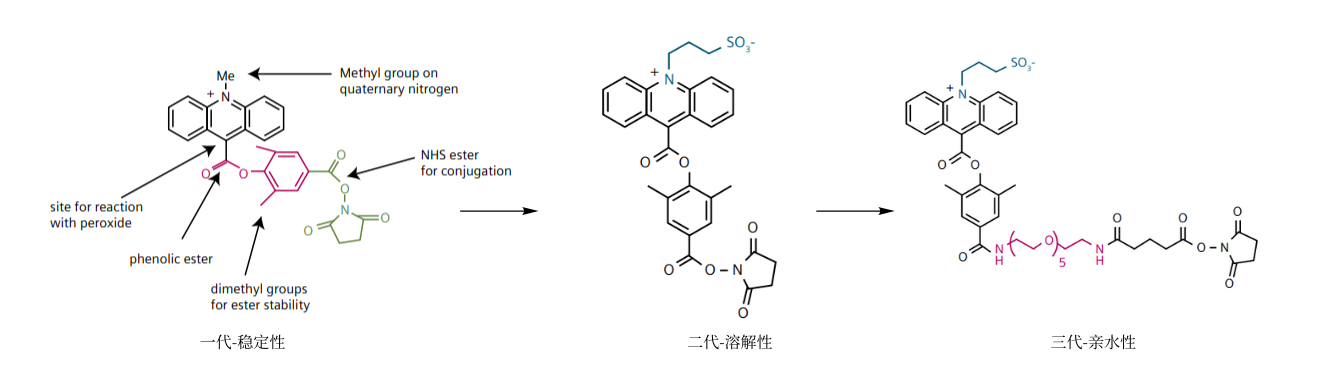
Figure 1 - The Three Generations of Molecular Changes in Acridinium Ester
Adhering to the spirit of continuous innovation, our R&D work has advanced to the forefront. HQYAE with higher quantum yield and NSP-DMAE-Z-NHS with better solubility are under intensive development and will be launched successively to comprehensively meet your different needs for chemiluminescent labels.
NSP-DMAE-HEG-Glu-NHS belongs to the category of direct chemiluminescent labels. Its luminescence mechanism is simple, fast, and efficient:
1. Trigger Reaction: The acridinium ester molecule is instantly excited in an alkaline hydrogen peroxide (H₂O₂) solution.
2. Flash Release: The excited-state molecule rapidly decays, releasing intense blue light with a wavelength between 430~480 nm. The entire process is completed within 1~5 seconds, forming a typical "flash-type" luminescence.
3. Pure Signal: Before luminescence, the luminescent moiety (acridone) has already dissociated from the labeled antibody or antigen, so the signal is not interfered by the structure of the biomacromolecule, resulting in extremely low background noise.
4. Advantage of Small Molecule: Its small molecular weight means labeling has minimal impact on the binding activity and spatial conformation of antigens and antibodies, making it particularly suitable for competitive immunoassays and ensuring detection accuracy.
This principle endows it with innate advantages of high quantum yield, high signal-to-noise ratio, and rapid detection, making it an ideal choice for achieving high-sensitivity, high-precision immunoassays.

Chinese Name: N-Sulfopropyldimethylacrylidium Ester-Hexaethylene Glycol-Glutarate NHS Active Ester
English Name: N-Sulfopropyl-Dimethyl Acridinium-Ester Hexa(ethylene) glycol-Glutarate N-hydroxysuccinimide
Abbreviation: NSP-DMAE-HEG-Glu-NHS
CAS Number: 1253933-74-2
Molecular Formula: C47H58N4O16S
Molecular Weight: 967.05
Specifications: 1 mg / 5 mg / 10 mg (Custom packaging supported)
Form: Lyophilized Powder
Cat. No.: G05010005
Stock Status: In Stock
Color: Blue
✅ High Sensitivity Detection
Quantum yield is increased by approximately 50%, resulting in stronger signals, significantly enhancing the detection sensitivity for low-concentration analytes.
✅ Second-Flash Anti-Interference
1~5 second rapid flash, peak wavelength 430~480 nm matches the high-sensitivity region of PMT, effectively avoiding fluorescence interference from biological matrices.
✅ Stable and Long-lasting
Classic dimethyl steric hindrance design effectively prevents ester bond hydrolysis, endowing the reagent with excellent anti-hydrolysis capability and storage shelf life.
✅ Convenient Conjugation
Features a built-in NHS active group, allowing direct conjugation with protein amino groups without the need for additional activation steps. Small molecule labeling does not damage activity.

Extended Services
One molecule, carrying three generations of evolution. One acridinium ester, defining a new height for domestic chemiluminescence.
For more chromogenic substrates or customized packaging services, please call +86 13302967066!
GeneSeqTools Bioscience & Technology is dedicated to providing reliable domestic alternative solutions for gene sequencing, molecular diagnostics, and microbial detection.
For related products such as blood cell dyes and buffer salts, you can view the complete product line and technical specifications on the 【MedSun Biotechnology Website】.

Founded in 2015, it is a high-tech enterprise focusing on microbial testing、 gene sequencing and in vitro molecular diagnostics in the R&D, production, and sales of biochemical reagent raw materials. Committed to providing high-quality biochemical reagent raw materials and professional custom synthesis services, the product portfolio covers more than a dozen categories and nearly a thousand innovative products. Upholding the core philosophy of “customer first, integrity and professionalism”, we serve with dedication to meet customers’ diverse needs in research and testing.

Official WeChat account: Shenzhen GeneSeqTools Bioscience & Technology Co. Ltd.
GeneSeqTools official website: http://www.geneseqtools.com
Hotline: +86 0755-23251735
QQ: 2370561481
Email: sales@geneseqtools.com
Related Links
- · FAQs about Geneseqtools BioTech [2024-07-04]
- · New In-Stock Product | Cy3-ddATP: A Fluorescent Chain-Terminating Nucleotide for Precise DNA End-Point Detection [2026-04-01]
- · Qingming Reflection, Renewal in Bloom | GeneSeqTools Qingming Holiday Notice [2026-04-02]
- · New In-Stock Product | 4MβNA Coagulase Peptide Substrate: Lighting Up Signals for Coagulase/Thrombin Detection [2026-04-10]
- · Hot Product [Domestic In-Stock] | DRAQ5 Dye: Efficient DNA Staining with Stable Coloration [2026-04-15]
- · New In-Stock Product | DRAQ7 Dye: A Far-Red Probe Designed Specifically for Dead Cell Nuclear Staining [2026-04-20]
- · New In-Stock Product | Anaerobic-β-D-Galactoside Substrate (GST1010): Anaerobic Chromogenicity, Orange-Yellow Signal Born for Anaerobic Detection [2026-04-23]
- · Recommended Series | Leukocyte Esterase Detection Substrates: A Complete Solution from Rapid Screening to Precise Analysis [2026-04-24]