



Product List

- News Center:
- Home>
- News Center>
- Company News>
- News Details
New In-Stock Product | 4-Methylumbelliferyl-β-D-Glucuronide (MUG, CAS: 6160-80-1): Fluorescent Substrate for E. coli Detection in National Standard Water Quality Testing
2026/6/3 14:00:45 Browse volume(309)MUG (CAS: 6160-80-1)
In environmental water quality monitoring and drinking water testing, Escherichia coli is an important indicator for evaluating microbial contamination and sanitary safety status.
Currently, enzyme substrate detection technology based on β-D-glucuronidase (β-GUS) activity has been incorporated into national drinking water standard testing methods, becoming an important technical support in the water quality microbial testing system. This method utilizes the characteristic that E. coli can express β-GUS, generating a recognizable signal through the reaction between a specific substrate and the enzyme, enabling rapid detection and interpretation of the target bacteria.
As a classic fluorescent substrate in the β-GUS detection system, 4-methylumbelliferyl-β-D-glucuronide (MUG, CAS: 6160-80-1) releases 4-methylumbelliferone (4-MU) under the action of β-GUS, producing a blue fluorescence signal. With its stable and reliable reaction performance, this substrate has been widely used in the development and standardization of environmental water quality, drinking water, and related microbial testing methods.


Chinese Name: 4-Methylumbelliferyl-β-D-glucuronide
English Name: 4-Methylumbelliferyl-β-D-glucuronide
Abbreviation: MUG / 4MU-GlcA
CAS Number: 6160-80-1
Molecular Formula: C16H16O9
Molecular Weight: 352.30
Specifications: 25 mg / 100 mg / 500 mg (Custom packaging supported)
Form: Off-white crystalline powder
Product Number: G01070012
Stock: In stock
Fluorescence Signal: Blue fluorescence (excited by 365 nm UV light)
β-GUS recognition + fluorescence release: converting target bacterial characteristics into detectable signals.
MUG (4-Methylumbelliferyl-β-D-glucuronide) is a classic fluorescent substrate designed for β-D-glucuronidase. In enzyme substrate detection technology, its detection process mainly includes the following three steps:
1. Specific recognition
E. coli can produce β-D-glucuronidase. This enzyme has high substrate specificity and is an important enzymatic marker for identifying E. coli in water quality testing.
2. Enzymatic hydrolysis reaction
When β-GUS is present in the sample, the enzyme specifically hydrolyzes the β-D-glucuronide bond in MUG, releasing free 4-methylumbelliferone (4-MU).
Reaction principle:
MUG + β-GUS → 4-MU + D-glucuronic acid
3. Fluorescence signal generation
The released 4-MU has fluorescent properties, producing a blue fluorescence signal when excited by 365 nm UV light. Testing personnel can interpret results by observing fluorescence (qualitative) or using fluorescence detection instruments.
1. Environmental water quality testing
Suitable for the determination of E. coli in environmental samples such as surface water, groundwater, domestic sewage, and industrial wastewater.
Using the specific hydrolysis reaction of β-GUS on MUG, the fluorescence signal indicates the presence of the target bacteria, suitable for evaluating the sanitary status of environmental water bodies and related detection system development.
2. Detection of total coliforms in drinking water
Suitable for the detection and analysis of total coliforms in drinking water.
In the enzyme substrate detection system, MUG is often used together with total coliform detection substrates, generating differentiated detection signals through different enzymatic reactions, enabling the simultaneous detection and differentiation of total coliforms and target bacteria.
3. Detection of E. coli in drinking water
Suitable for the detection of E. coli in drinking water sources, tap water, and packaged drinking water samples.
As a classic fluorescent substrate in the enzyme substrate detection system, MUG converts β-GUS activity into a recognizable fluorescence signal, providing a reliable enzymatic detection method for drinking water microbiological hygiene indicators.
✅ High purity, reducing background interference
• High purity control: Purity ≥98%, strict control of impurity residues, ensuring low and controllable background signals.
• Controllable background: Effectively reduces non-specific fluorescence impact, significantly improving detection system stability.
• Batch consistency: Industrial-grade production standards ensure high reproducibility of test results across different product batches.
✅ Specific recognition, clear response
• Precise recognition: Uses β-D-glucuronide group as the recognition site, specifically hydrolyzed by β-GUS.
• Signal correlation: Fluorescence generation is directly related to enzyme activity.
• Clear detection: Clear reaction pathway, easy to establish standardized detection procedures.
✅ Fluorescence interpretation, convenient operation
• Classic fluorophore: Releases 4-MU upon enzymatic cleavage, producing a blue fluorescence signal.
• Intuitive reading: Typical detection conditions are excitation at 365 nm and emission at 445 nm.
• Equipment compatibility: Compatible with mainstream fluorescence microplate readers and detection platforms.
✅ Mature application, easy system development
• Wide application: As a classic fluorescent substrate in the β-GUS detection system, it has been widely used in E. coli detection systems in the water quality testing field.
✅ In-stock direct supply, ensuring supply rhythm
• Multiple specification inventory: Regularly stocked domestically to meet different scale needs.
• Controllable delivery time: Reduces the risk of cycle fluctuations caused by import dependence.
• Continuous supply: Supports stable supply from research validation to large-scale production.
In the enzyme substrate method, different detection indicators require matching different substrates. GeneSeqTools Bioscience & Technology provides a full range of substrate products related to water quality testing:
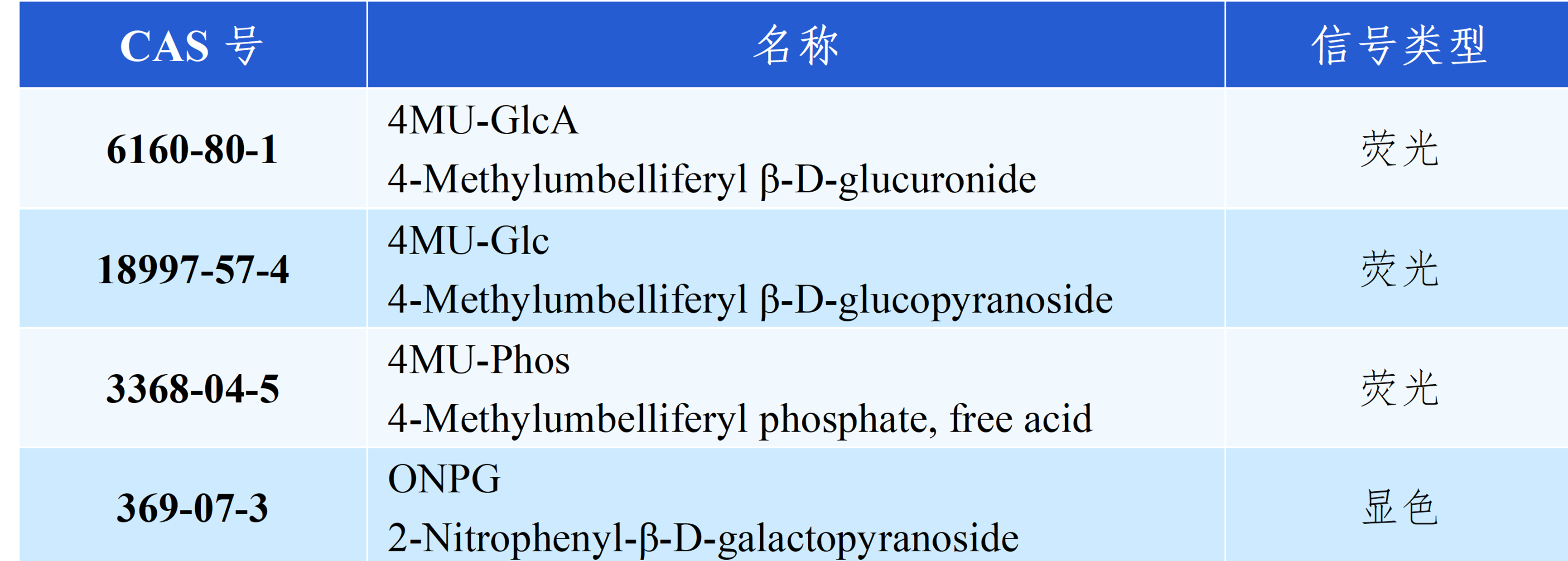

Extended Services
Classic MUG substrate, providing reliable fluorescence signal for E. coli detection in water quality.
For more "β-D-glucuronidase substrates" or custom services, please call +86 13302967066!
GeneSeqTools Bioscience & Technology is dedicated to providing reliable domestic alternative solutions for gene sequencing, molecular diagnostics, and microbial detection.
For related products such as blood cell dyes and buffer salts, you can view the complete product line and technical specifications on [MedSun Biotechnology Website].

Founded in 2015, it is a high-tech enterprise focusing on microbial testing、 gene sequencing and in vitro molecular diagnostics in the R&D, production, and sales of biochemical reagent raw materials. Committed to providing high-quality biochemical reagent raw materials and professional custom synthesis services, the product portfolio covers more than a dozen categories and nearly a thousand innovative products. Upholding the core philosophy of “customer first, integrity and professionalism”, we serve with dedication to meet customers’ diverse needs in research and testing.

Official WeChat account: Shenzhen GeneSeqTools Bioscience & Technology Co. Ltd.
GeneSeqTools official website: http://www.geneseqtools.com
Hotline: +86 0755-23251735
QQ: 2370561481
Email: sales@geneseqtools.com
Related Links
- · FAQs about Geneseqtools BioTech [2024-07-04]
- · Raw Materials as the Foundation, Innovation as the Drive | GeneSeqTools at the 20th Academic Symposium on Microbial Culture Media [2026-09-29]
- · In Stock | Key Raw Material for Salmonella Chromogenic Media: Application Analysis of Magenta-Caprylate [2026-09-30]
- · In Stock | Hard to Tell Colony Morphologies Apart? Butyrate Esterase Detection Adds Another Discriminating Dimension [2026-10-10]
- · In Stock | Salmonella Chromogenic Media Formulation: Why a Blue C8 Esterase Substrate Is Needed Beyond Magenta [2026-10-13]
- · Hot Product | H-Ala-AMC ∙ TFA: Application of an Aminopeptidase Fluorogenic Substrate in Microbial Identification [2026-10-16]
- · In Stock | Chromogenesis Is More Than Just Choosing a Dye: Application of Fast Garnet GBC Base in Enzymatic Chromogenic Systems [2026-10-22]
- · In Stock | From Enzymatic Marker to Chromogenic Media: Applications and Selection Strategy for X-Glc [2026-10-23]